


If you live in a high-rise society in Noida or Greater Noida, you’ve likely seen the massive electricity bills for “Common Area Maintenance” (CAM). Lighting up basements, running lifts, and powering water pumps costs lakhs every month.
While RWA (Resident Welfare Associations) want to install solar to cut these costs, one technical confusion stops them: The NPCL Connection Type.
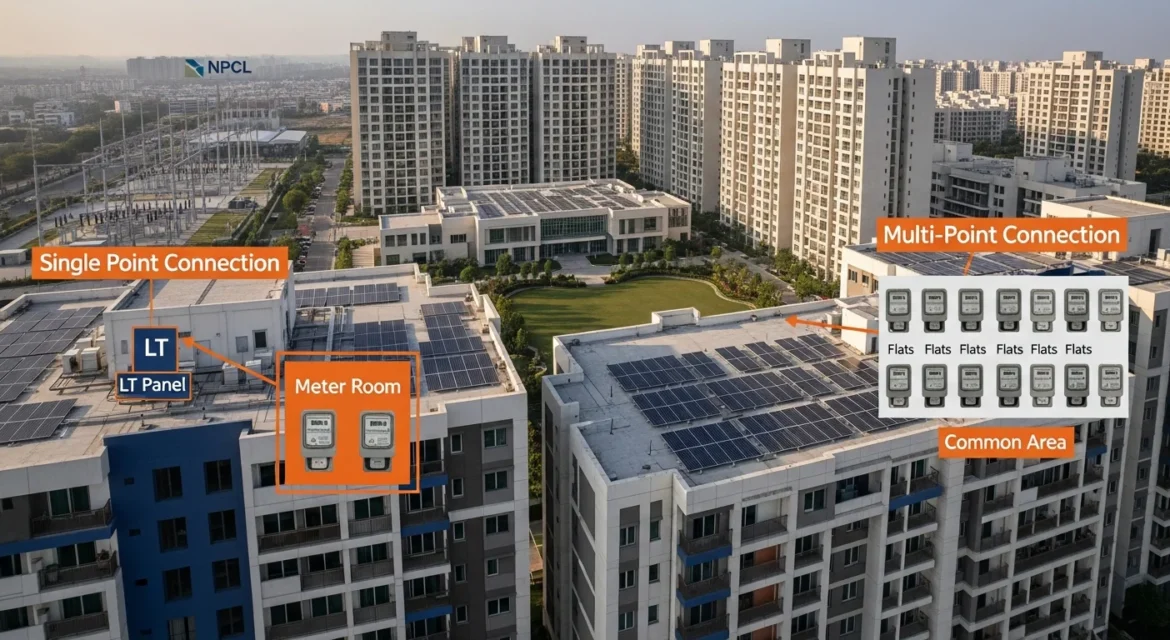
Does your society have a Single Point Connection or a Multi-Point Connection? The answer changes how you can install solar.
Scenario 1: Single Point Connection (The “Bulk” Model)
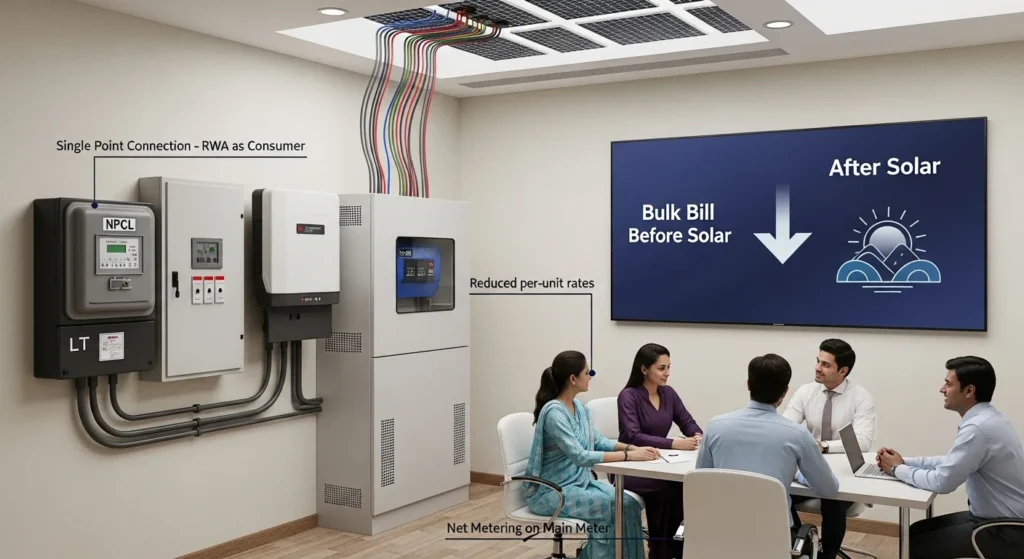
Most older societies in Noida (like those in Sector 93, 137, etc.) operate on a Single Point Connection. Here, NPCL provides one main meter to the builder/RWA, who then sub-meters electricity to individual flats.
- Solar Feasibility: High.
- How it works: The RWA acts as the “consumer.” You can install a large
- On-Grid Solar System (e.g., 100kW or 200kW) connected directly to the main LT panel.
- Net Metering: NPCL replaces the main single-point meter with a bi-directional meter. The solar power generated offsets the entire society’s consumption (Common Area + Residents’ usage).
- Benefit: The bill sent by NPCL to the RWA drops drastically. The RWA can then pass on savings by reducing the per-unit rate charged to residents or lowering maintenance fees.
Scenario 2: Multi-Point Connection (The “Individual” Model)
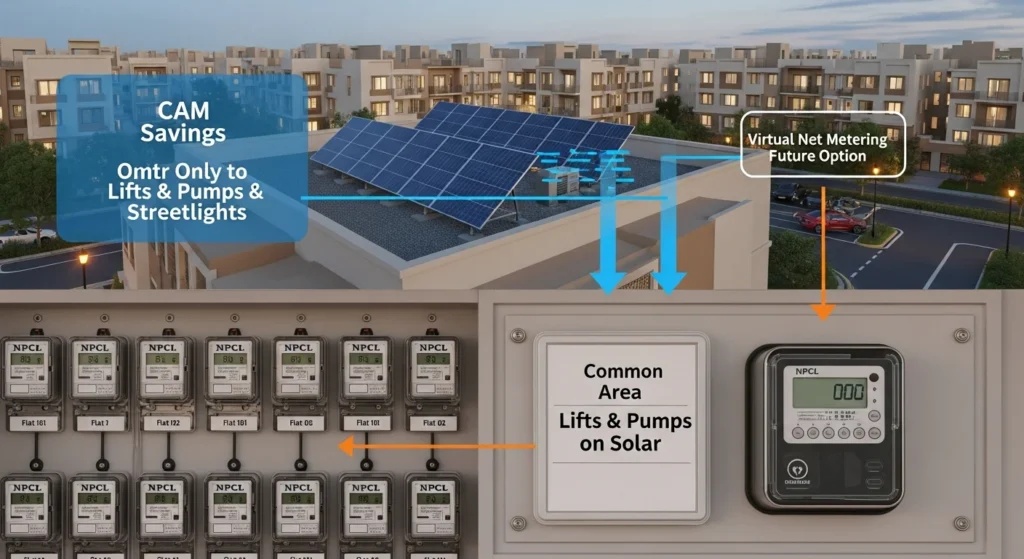
Under new UPERC guidelines, many societies are converting to Multi-Point Connections. Here, every flat has a direct meter with NPCL. The RWA only has a separate connection for “Common Area Services.”
- Solar Feasibility: Targeted.
- How it works: You cannot install one giant plant for the whole society because there is no single “main meter” for residents.
- The Solution: The RWA installs a solar plant only for the Common Area Connection (lifts, pumps, streetlights).
- Net Metering: The net meter is installed on the Common Service meter.
- Benefit: This zeros out the electricity cost for lifts and pumps, directly reducing the monthly CAM charges for residents.
Virtual Net Metering: The Future?
Delhi has introduced “Virtual Net Metering” where panel owners in a society get credits on their individual bills from a shared solar plant. While Uttar Pradesh is exploring this under the Solar Energy Policy 2022, full implementation in Noida is still in the pilot phase. For now, the “Common Area Offset” model is the most practical choice for Multi-Point societies.
Rooftop Rights: The Biggest Hurdle
Technically, the roof belongs to the builder until the project is handed over to the RWA (AOA).
- If Builder Handover is Pending: The builder must apply for the solar connection.
- If RWA is Formed: The RWA can pass a resolution in the AGM (Annual General Meeting) to utilize the terrace for solar.
- Elevated solar structures are popular here as they allow residents to keep using the roof for walking or parties.
Conclusion
Whether you have a Single Point or Multi-Point connection, solar is viable. For Single Point societies, it slashes the bulk bill. For Multi-Point societies, it kills the CAM electricity cost. The key is to check your sanctioned load with NPCL and design a system that maximizes the net metering benefits.
FAQ’S
Q1: Can an individual flat owner install solar in a high-rise society?
Generally, no. Roof rights are shared. Individual installation is only possible if you have exclusive terrace rights (like in penthouses) and RWA NOC.
Q2: What is the maximum solar capacity a society can install?
Under NPCL net metering, you can typically install solar up to 100% of your sanctioned load (e.g., if common load is 200kW, you can install 200kW solar).
Q3: Does the government give subsidy for society solar plants?
Yes! Under PM Surya Ghar Yojana, RWAs/Group Housing Societies get a subsidy of ₹18,000 per kW, capped at 500 kW per society (for common areas).
Q4: We have a diesel generator. Can we still use solar?
Absolutely. You need a PV-DG Synchronization device to ensure solar and DG run together during power cuts, saving diesel.
Q5: Who maintains the solar plant in a society?
The EPC vendor usually provides 5 years of AMC (Annual Maintenance Contract). After that, the RWA takes over or renews the contract.