


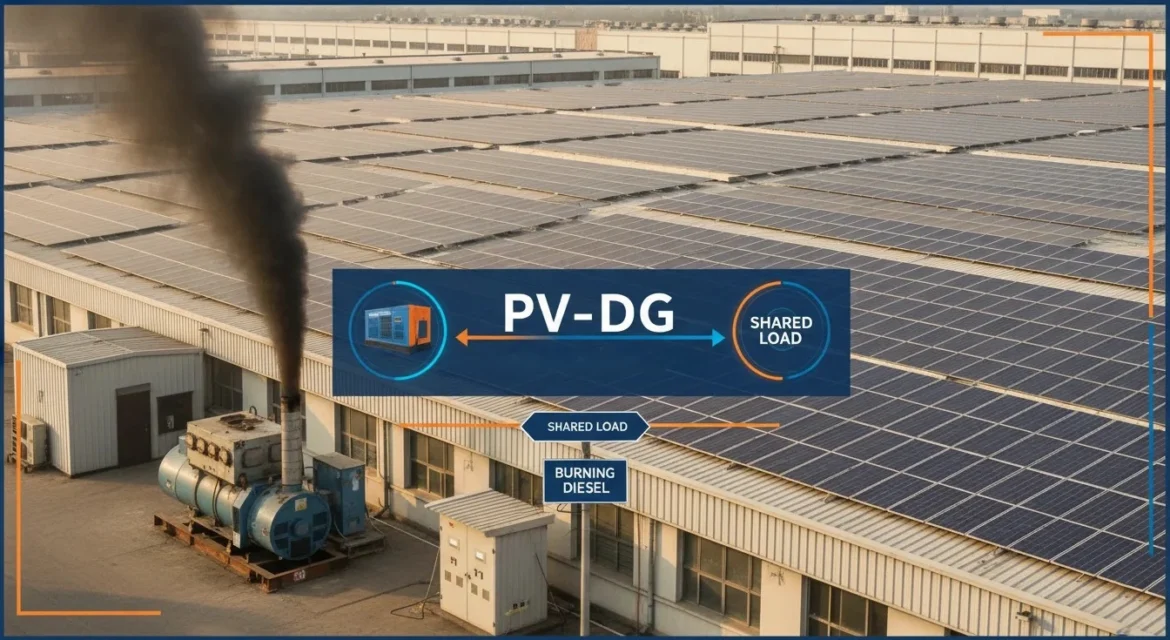
In Noida’s industrial sectors—from Sector 63 to Greater Noida—diesel generators (DGs) are a necessary evil. With frequent power fluctuations and “load shedding,” factories often rely on DGs for hours. But with diesel prices hovering around ₹88 per liter in 2026 and stricter GRAP (Graded Response Action Plan) bans, running a factory on pure diesel is burning a hole in your balance sheet.
The solution isn’t just “installing solar”—it is PV-DG Synchronization.
This technology allows your solar plant to run simultaneously with your diesel generator, drastically reducing fuel consumption. Instead of choosing between Solar OR Diesel, you get the best of both.
The Problem: The “Zero Export” Trap
Many factory owners in Noida believe that when the grid fails, their On-Grid solar plant must shut down. This is partially true for standard setups due to “anti-islanding” safety features. Without synchronization, if you run solar with a DG, the solar panels might produce more power than the load requires. This excess power can flow back into the generator, causing reverse power faults and permanent engine damage.
So, most industries simply turn off their solar inverters during power cuts, wasting free energy and burning expensive diesel.
The Solution: How PV-DG Synchronization Works
PV-DG synchronization in Noida is becoming a standard for smart industries. A specialized controller (often a Zero Export Device or DG Sync Controller) sits between your solar inverters, the grid, and the DG set.
Here is the step-by-step logic:
- Handshake: When the grid fails and the DG starts, the controller “wakes up” the solar inverters.
- Load Sharing: If your factory load is 100 kW and your solar is generating 60 kW, the controller tells the DG to produce only the remaining 40 kW.
- Fuel Saving: Instead of burning fuel for 100 kW, your DG idles at a lower capacity, saving 40-60% on diesel instantly.
- Protection: If the factory load drops to 50 kW (below solar generation), the controller instantly throttles the solar output to match the load, ensuring zero reverse power to the DG.
Financial Impact for Noida Factories
Let’s look at the numbers. A 250 kVA DG consumes roughly 40-50 liters of diesel per hour at full load.
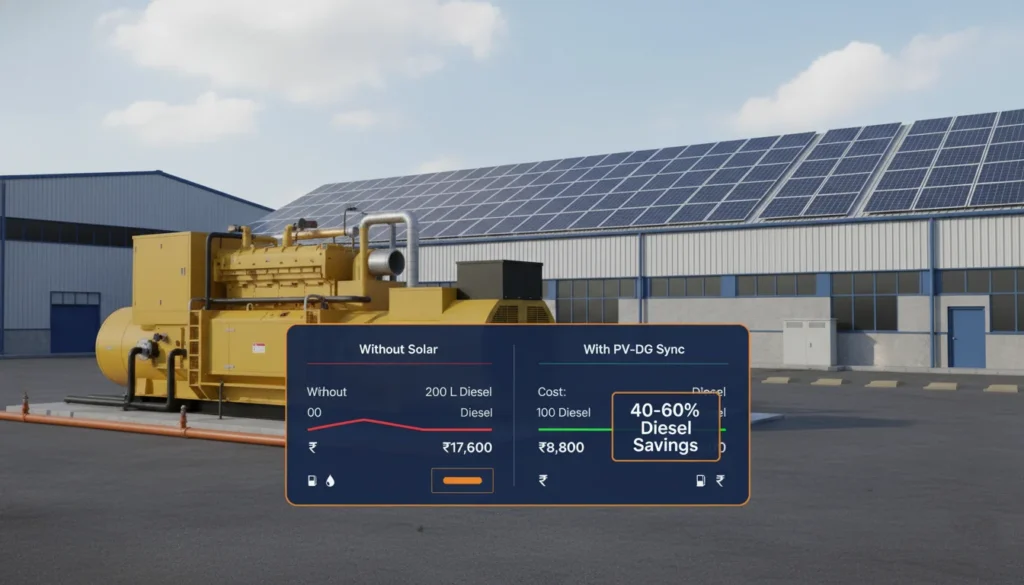
- Without Solar: 5 hours of outage = 200 liters × ₹88 = ₹17,600.
- With PV-DG Sync: Solar takes 60% load. DG fuel drops to ~20 liters/hr. Cost = ₹8,800.
That is a savings of ₹8,800 per day during peak summer outages. Over a year, this pays for the solar panel prices and the controller costs multiple times over.
Technical Implementation & IoT
Implementing this requires more than just hardware; it needs intelligent engineering. You need inverters that support “active power curtailment.” Checking the best solar inverters in India is crucial to ensure they have the communication protocols (Modbus/SunSpec) to talk to the sync controller.
Furthermore, integrating this with industrial control panels allows for automated load shedding. If solar generation drops due to clouds, the system can automatically trip non-essential loads to keep the DG stable.
Maintenance and Reliability
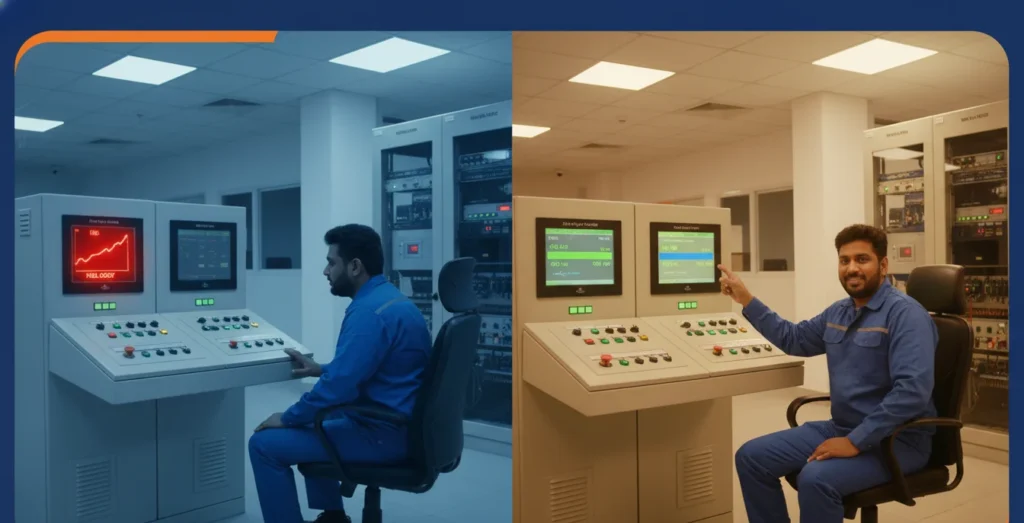
A synchronized system is complex. A slight lag in communication between the DG and Solar Inverter can trip the system. This is where predictive maintenance comes in. Using IoT sensors, we can monitor the millisecond-response times of the controller and the health of the DG, ensuring 99.9% uptime.
Conclusion
For Noida industries, the era of burning diesel for full power backup is over. PV-DG synchronization offers a path to reduce operational expenses significantly. It extends the life of your generator (by reducing load stress) and ensures you harvest every unit of solar energy, even when the grid is down.
FAQ‘S
Q1: Can I retrofit PV-DG synchronization on my existing solar plant?
Yes, we can retrofit a DG Sync controller to almost any existing grid-tied solar plant, provided the inverters support power throttling control.
Q2: Will solar power damage my diesel generator?
No, provided you use a high-quality “Zero Export” or “Reverse Power Protection” device that prevents excess solar energy from feeding back into the alternator.
Q3: How much diesel can I save with PV-DG sync?
Depending on your solar capacity and daylight hours, industries typically see diesel fuel savings of 40% to 60% during power outages.
Q4: Does this work during night shifts?
No, PV-DG synchronization works only when solar generation is available (daytime); at night, the DG will take the full load as usual.
Q5: Is this technology approved by NPCL/UPPCL in Noida?
Yes, this is an “behind-the-meter” optimization for your internal grid and does not interfere with the utility meter or net metering policies.