


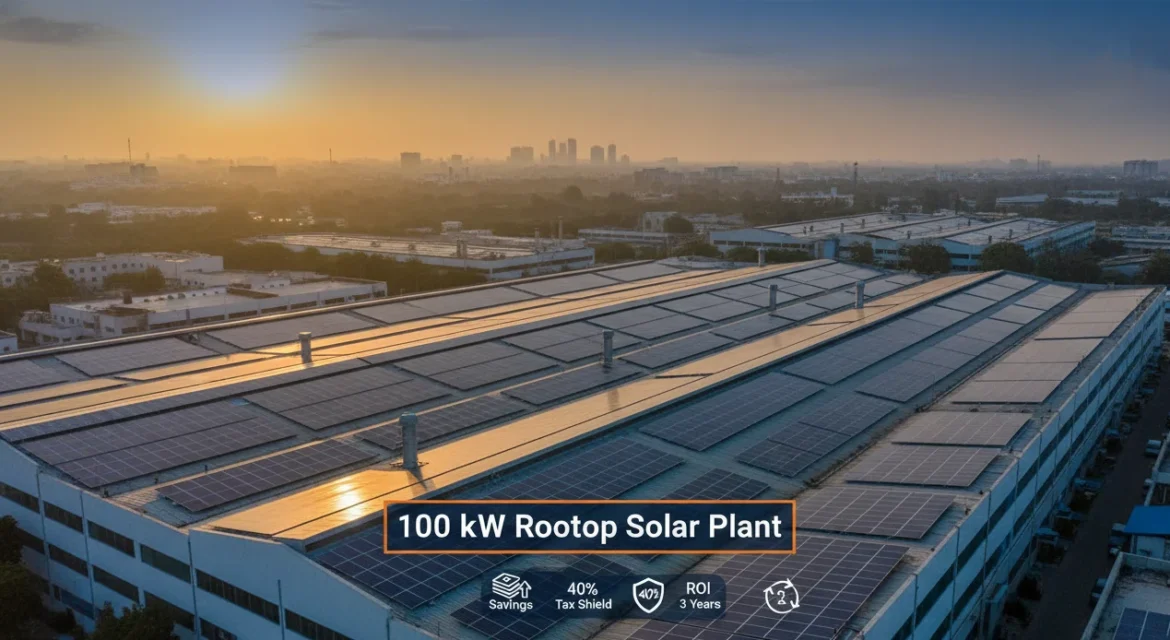
Noida’s Sector 63 is undergoing a quiet but massive energy transformation. As one of the NCR’s busiest industrial hubs, factory owners no longer view power simply as a utility bill to be paid, but as a controllable operational cost. The driver? A strategic combination of rising grid tariffs and the 40% Accelerated Depreciation benefit.
For industrial units running heavy machinery, the math is simple: grid electricity costs are rising, but the tax incentives for renewable adoption have never been better. This shift isn’t just about “going green”—it is about financial survival and competitive advantage in a tight market.
The Current Financial Squeeze in Sector 63
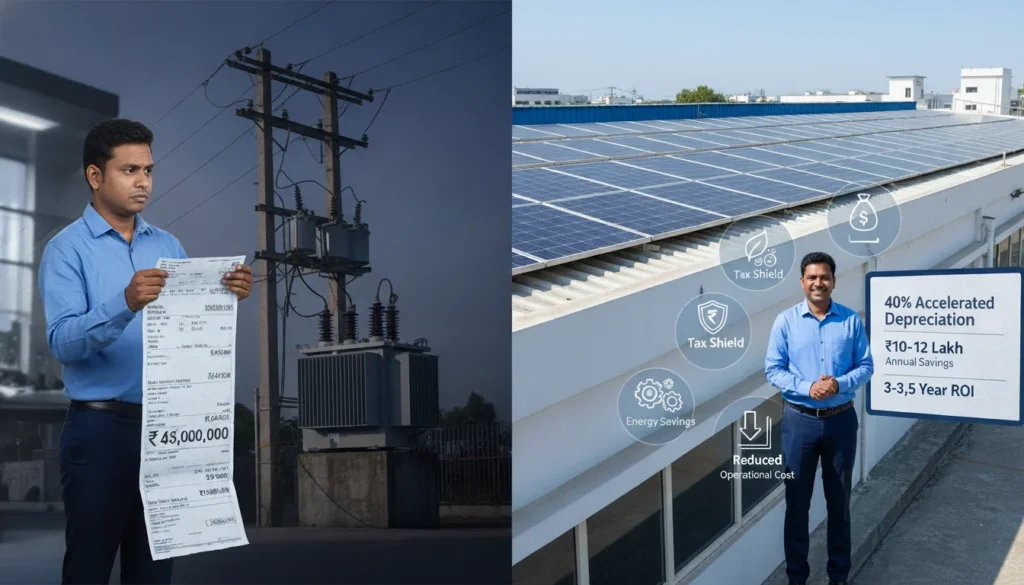
Most medium-scale industries in Noida Sector 63 operate on 11kV commercial connections, where tariffs often hover between ₹7.70 and ₹8.50 per unit (kVAh). For a factory with a monthly bill of ₹5 Lakhs, electricity constitutes a massive chunk of operational overheads.
However, the real pain point isn’t just the unit rate; it’s the inefficiency. Many older factories suffer from poor power factors and unmanaged peak loads. Addressing this requires more than just solar panels; it demands a holistic approach involving industrial control panels that can actively manage energy distribution.
The 40% Tax Shield: How It Works
The primary catalyst for the current solar boom is Section 32 of the Income Tax Act. Unlike residential users who rely on direct subsidies, industrial users benefit from Accelerated Depreciation (AD).
- The Benefit: You can claim 40% of the solar project value as depreciation in the very first year.
- The Math: If you install a 100kW system costing ₹40 Lakhs, you claim ₹16 Lakhs as depreciation in Year 1. For a company in the 25% tax bracket, this results in a direct cash flow saving of ₹4 Lakhs immediately.
- The ROI: When you combine this tax shield with annual electricity savings (approx. ₹10-12 Lakhs for a 100kW plant), the Return on Investment (ROI) period shrinks to just 3–3.5 years.
Smart Integration: Beyond Basic Solar
Installing panels is step one. The factories maximizing their returns in 2026 are those integrating solar with intelligent MCC panels.
Why is this integration critical?
- Load Synchronization: Smart panels ensure that heavy loads (like compressors or molding machines) run during peak solar generation hours (11 AM – 2 PM).
- Peak Shaving: By reducing grid draw during peak hours, factories lower their “Maximum Demand” charges on electricity bills.
- Voltage Stability: Solar inverters paired with smart distribution units help stabilize voltage fluctuations, which is crucial for protecting sensitive CNC machines.

Addressing the “Dust and Shadow” Challenge
Sector 63 is dusty and dense. A common hesitation for factory owners is the fear of dust reducing solar panel efficiency.
- The Solution: Modern EPC installations now include robotic dry-cleaning systems and IoT-based monitoring.
- Predictive Tech: Leveraging predictive maintenance allows facility managers to detect specific strings of panels that are underperforming due to dust or loose connections (often MC4 faults) before they impact total generation.
Practical Implementation Framework for Noida Factories
Phase 1: Energy Audit & Shadow Analysis (Week 1-2)
Before procuring hardware, conduct a drone-based shadow analysis. Sector 63 has many adjacent tall buildings. Identifying shadow-free zones is critical. Simultaneously, audit your current load to right-size the system.
Phase 2: Technology Selection (Week 3-4)
Don’t settle for older Poly panels. Opt for Mono-PERC or Bifacial modules. While looking at solar panel prices, remember that bifacial panels can generate power from reflected light off the roof surface, adding 10-15% more generation in tight spaces.
Phase 3: Grid Liaisoning & Net Metering (Month 2)
Work with an EPC who understands the specific paperwork for NPCL (Noida Power Company Limited) or UPPCL. Delays here are the most common bottleneck.
Phase 4: O&M and Monitoring (Ongoing)
Once live, shift focus to monitoring. Use an app-based dashboard to track daily generation and tax savings in real-time.
The Path Forward
For factory owners in Sector 63, the question is no longer “Should we install solar?” but “How quickly can we execute?” With the 40% depreciation benefit potentially subject to future policy changes, locking in this asset now secures a low-cost energy future for the next 25 years. By combining financial incentives with smart engineering, Noida’s industries are not just saving money—they are future-proofing their operations.
FAQ’S
Q1: Can I claim Accelerated Depreciation if I also take a solar subsidy?
Generally, you must choose one; for businesses, the 40% tax depreciation usually offers a higher financial benefit than standard capital subsidies.
Q2: How does dust in Sector 63 affect solar generation?
Heavy dust can reduce generation by 15-20%, which is why automated cleaning systems or bi-monthly manual cleaning cycles are essential.
Q3: What is the minimum roof area needed for a 50kW industrial solar plant?
You typically need about 500 sq. meters (approx. 5,000 sq. ft) of shadow-free roof area for a standard 50kW installation.
Q4: Can solar power run my heavy 3-phase industrial machinery?
Yes, grid-tied solar systems work seamlessly with 3-phase loads; any power shortage is instantly drawn from the grid without interruption.
Q5: What happens to the excess power my factory generates on Sundays?
Through net metering, excess power is exported to the grid, earning you credits that are adjusted against your bill in the following months.