


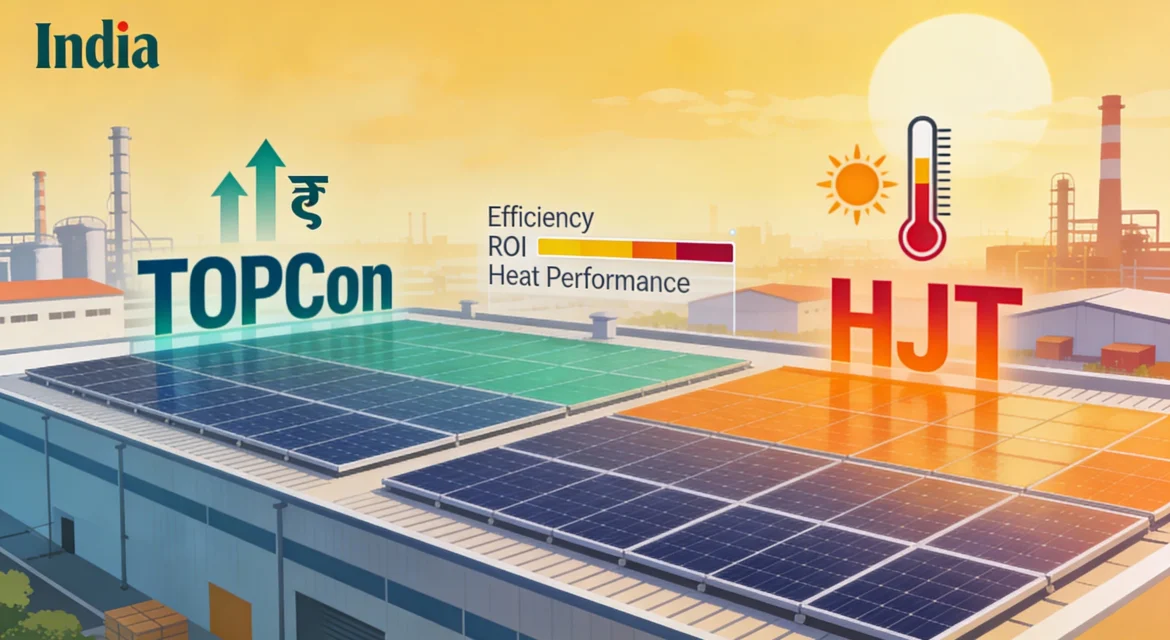
For factory owners in India, the equation is simple: higher solar efficiency equals lower electricity bills. But in 2025, the technology landscape has shifted. The old standard (PERC panels) is fading, replaced by two heavyweights: TOPCon (Tunnel Oxide Passivated Contact) and HJT (Heterojunction) technology.
If you are planning a solar EPC project for your manufacturing unit in Delhi NCR or Haryana, choosing the right panel technology is critical. A wrong choice could mean losing 5-10% of potential generation during peak summer months.
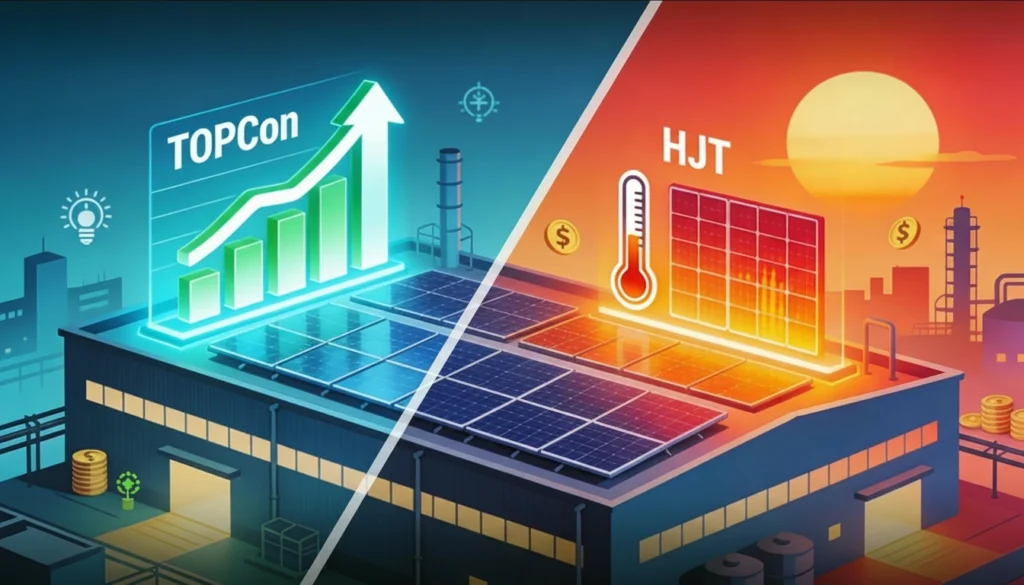
Here is a technical yet practical breakdown of TOPCon vs. HJT to help you decide which technology yields the best ROI for industrial use.
1. The Efficiency Battle: Which Generates More Power?
Both technologies are “N-Type” cells, meaning they are inherently more efficient than older P-Type panels. However, they handle sunlight differently.
- TOPCon: Currently the market leader for industrial solar setups. These panels typically offer 24-25% efficiency. They are excellent at squeezing more power out of the same roof space compared to older modules.
- HJT: The premium contender. HJT panels can push efficiency towards 26-27%. They combine crystalline silicon with thin-film silicon, capturing a broader spectrum of sunlight.
- Verdict: For limited rooftop space (e.g., a crowded textile factory roof), HJT wins on raw power density.
2. Performance in Indian Heat (Temperature Coefficient)
This is the most critical factor for factories in North India, where ambient temperatures hit 45°C+. Solar panels lose efficiency as they get hotter.
- TOPCon: Has a temperature coefficient of around -0.29% per °C. This is good, but it still means some power loss during a June heatwave.
- HJT: shines here with a coefficient as low as -0.26% per °C.
- Real-World Impact: On a scorching afternoon in Noida, an HJT system will generate roughly 3-5% more electricity than a TOPCon system of the same nameplate rating because it stays “cooler” electrically.
3. Bifaciality: Using Your Factory Roof’s Reflection
Most industrial solutions now use bifacial panels (collecting light from both sides).
- HJT is naturally symmetrical, offering a high “bifaciality factor” of up to 85-90%. If your factory has a reflective white or light-colored metal roof, HJT panels will pick up significant bonus energy from the rear side.
- TOPCon offers around 80% bifaciality. It is efficient, but HJT captures more reflected light.
4. Cost vs. ROI for SME Owners
Here is where the rubber meets the road.
- TOPCon: Is the “value champion.” Because it uses manufacturing lines similar to older tech, it is cheaper to produce. The ROI period for a 100kW TOPCon system is typically 3.5 to 4 years.
- HJT: Is expensive to manufacture. Expect to pay 15-20% more upfront. While it lasts longer (30-year lifespan vs. 25), the ROI pushes to 4.5 – 5 years.
5. Recommendation: What Should You Buy?
- Go for TOPCon if: You want the best balance of high performance and quick payback. It is the new industry standard for 80% of commercial solar projects.
- Go for HJT if: You have a very small roof but high power needs, or if you are building a premium “Green Building” facility where maximum generation over 30 years matters more than upfront cost.
At SIA Engineering, we specialize in customizing these electrical engineering solutions for industrial clients. We don’t just install; we calculate your specific site’s generation potential before recommending a module.
Frequently Asked Questions (FAQs)
Q1: What is the main difference between TOPCon and HJT solar panels?
A: TOPCon is an upgrade to standard silicon cells offering high efficiency at a lower cost, while HJT combines two silicon types for superior performance and heat resistance but at a higher price.
Q2: Which solar panel is better for high-temperature cities like Delhi?
A: HJT panels are better for hot climates because they have a lower temperature coefficient, meaning they drop less power during peak summer heat than TOPCon.
Q3: Are HJT panels worth the extra cost for a factory rooftop?
A: Only if your roof space is very limited or you have a highly reflective roof; otherwise, TOPCon offers a faster Return on Investment (ROI) for most industries.
Q4: Do TOPCon panels degrade faster than HJT?
A: Both are very stable, but HJT typically has a slightly lower degradation rate (0.25% per year) compared to TOPCon (0.4% per year), giving HJT a longer effective lifespan.
Q5: Can I upgrade my existing solar plant with these new panels?
A: Yes, but you may need compatible inverters; consult an EPC contractor like SIA Engineering to ensure your electrical panels and mounting structures can handle the new technology.